
Quick Summary
This guide compares chain slings and wire rope slings across the key factors that affect sling selection: construction, abrasion resistance, temperature suitability, flexibility, and inspection requirements. It covers Grade 80 chain slings, multi-leg configurations, and a practical step-by-step selection checklist to help you choose the right sling for your lift.
The wrong sling for the job does not simply slow a project down. In a lifting operation, an unsuitable sling can put people and equipment at serious risk.
Choosing the right lifting sling is an important part of any safe lifting operation. Whether you are handling steel components on a construction site, moving heavy machinery in an industrial facility, or lifting equipment in marine and offshore environments, the sling must suit the load, working conditions, and lifting method.
Two common options are chain slings and wire rope slings. Both are designed for lifting heavy loads, but they differ in construction, flexibility, resistance to wear, and suitability for particular applications.
Understanding the difference between a chain sling and a wire rope sling helps you select equipment that meets your lifting requirements without compromising safety or efficiency.
Chain slings are often preferred for demanding applications involving abrasion, rough loads, and elevated temperatures within the manufacturer’s specified limits. Wire rope slings are widely used for heavy industrial lifting where strength, durability, and flexibility are important.
So, which one should you choose?
The answer depends on several factors, including the weight and shape of the load, the lifting environment, the sling configuration, and the working load limit required. This guide explains these differences and helps you make a more informed decision.
What Is the Difference Between a Chain Sling and a Wire Rope Sling?
The main difference lies in how each sling is constructed and how that construction affects its performance.
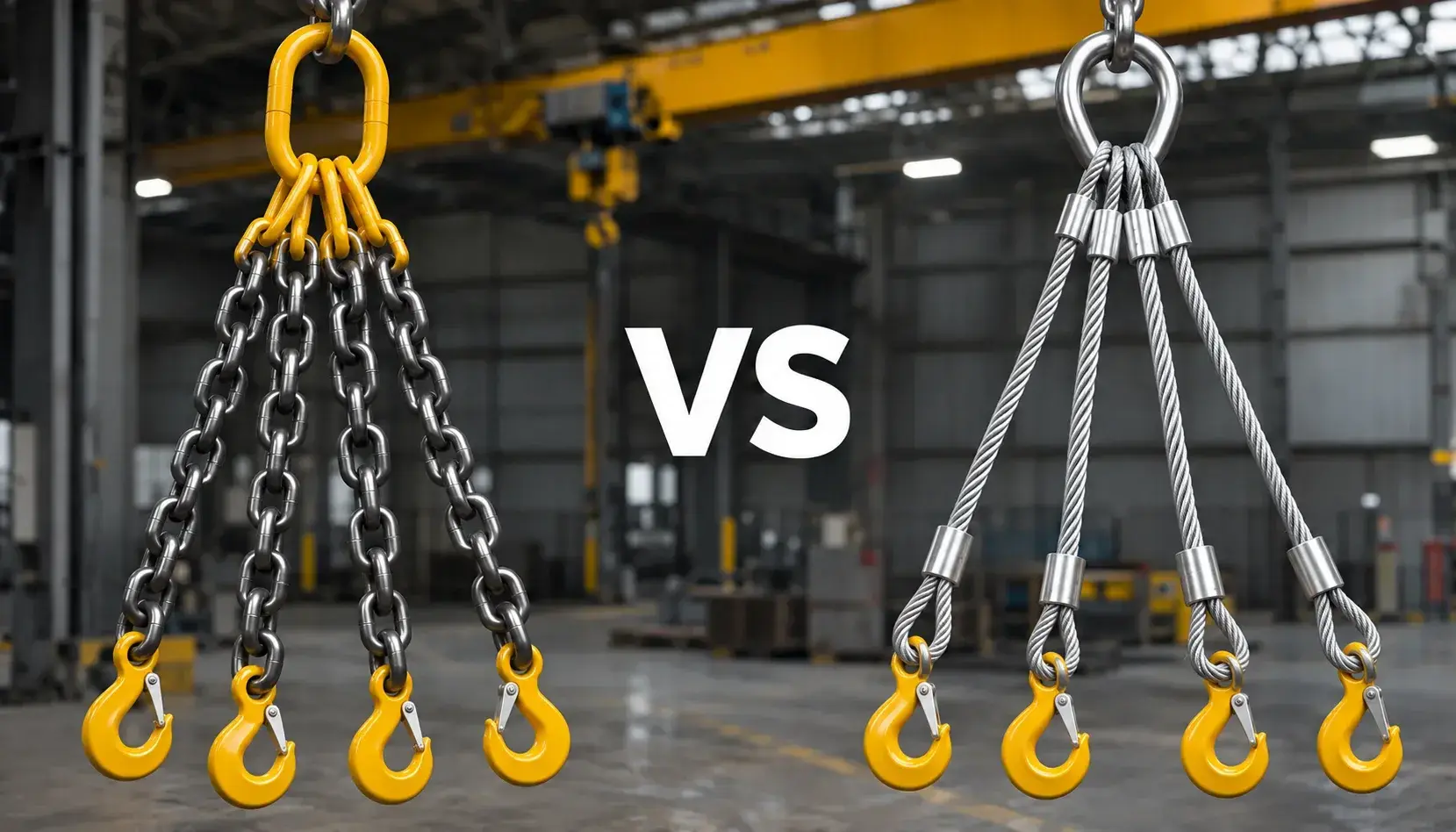
A chain sling consists of interconnected links made from suitable lifting-grade chain, commonly alloy steel for overhead lifting. A wire rope sling is made from steel wires twisted into strands, which are then laid together to form a rope. The rope is assembled with suitable end fittings or loops to create a lifting sling.
Both types are available in different sizes, capacities, and configurations. Their suitability depends on the specific design and manufacturer’s rated capacity, not simply on whether the sling is made from chain or wire rope.
Chain Sling
A chain sling is designed for demanding lifting applications where a durable, adaptable sling is needed. Alloy steel chain slings can accommodate rough handling and abrasive contact better than many other sling materials, provided they are used within their rated limits and inspected correctly.
They are commonly available in single-leg and multi-leg configurations, with suitable hooks, master links, and other lifting attachments.
Wire Rope Sling
A wire rope sling uses a steel rope assembly to support and lift a load. Its construction combines strength with flexibility, allowing it to conform to certain load shapes and work with different lifting arrangements.
Wire rope slings are used across construction, manufacturing, material handling, and heavy industrial operations. Their performance depends on rope diameter, construction, core, end fittings, and the way the sling is used. Because the rope itself is the starting point of every assembly, it also helps to understand the steel wire rope options (galvanized, un-galvanized, and non-rotating) behind the sling you choose.
Chain Sling vs Wire Rope Sling: Key Differences
The following comparison highlights the main factors to consider when choosing between these two types of lifting equipment.
| Factor | Chain Sling | Wire Rope Sling |
|---|---|---|
| Construction | Interconnected lifting-grade steel links | Steel wires formed into strands and rope |
| Abrasion resistance | Generally well suited to rough loads and abrasive contact | Good abrasion resistance, depending on rope construction and application |
| Flexibility | Articulated links allow the sling to adapt to different lifting arrangements | Rope construction provides flexibility and can conform to suitable load shapes |
| Temperature suitability | Suitable for certain elevated-temperature applications within specified limits | Depends on rope core, construction, attachments, and manufacturer limits |
| Inspection | Requires checks for wear, cracks, stretching, deformation, and damaged links | Requires checks for broken wires, corrosion, kinks, crushing, deformation, and damaged fittings |
| Configuration | Available in single-leg and multi-leg assemblies | Available in single-leg, multi-leg, and other manufacturer-approved assemblies |
| Common applications | Rough industrial loads, steel components, and demanding lifting environments | Construction, machinery handling, structural components, and general heavy lifting |
| Best selection criteria | Load requirements, grade, chain condition, configuration, and environment | Load requirements, rope construction, diameter, condition, configuration, and environment |
Neither option is automatically stronger or safer than the other. The correct choice depends on the complete sling assembly, its working load limit, and the conditions of use.
WHICH LIFTING SLING IS RIGHT FOR YOUR APPLICATION?
Apex Lifting supplies Grade 80 chain slings and wire rope sling assemblies to oil and gas, marine, and construction operations across the UAE and GCC. Our team can help you identify the right configuration for your load and environment.
What Are the Main Chain Sling Uses?
Chain slings are particularly useful when the lifting operation involves rough materials, abrasive contact, or conditions that may be unsuitable for other sling materials.
1. Lifting Steel Components and Heavy Materials
Steel sections, fabricated metal components, and other industrial materials may have rough surfaces or edges that can cause damage to unsuitable lifting equipment.
A properly selected chain sling can be suitable for these applications because alloy steel chain offers good resistance to abrasion. However, sharp edges still require appropriate protection, and the sling must not be exposed to damaging point loads.
2. Construction and Industrial Lifting
Construction and industrial sites frequently handle structural components, machinery, and fabricated assemblies.
Depending on the load and lifting arrangement, a chain sling can provide a practical solution for connecting a load to a crane or other approved industrial lifting equipment. The sling must be selected according to the load’s weight, centre of gravity, attachment points, and the capacity of every component in the assembly.
3. Applications Involving Elevated Temperatures
Certain alloy steel chain slings can be used in elevated-temperature environments where other sling materials may be unsuitable.
However, the chain does not have unlimited heat resistance. High temperatures can affect the material and reduce the allowable capacity. Always follow the manufacturer’s temperature limits and any required working load limit reductions.
4. Lifts Requiring Adjustable Configurations
Chain sling assemblies can be manufactured in different lengths and configurations to suit specific lifting requirements. Some systems include approved shortening components that allow adjustment when required.
Any adjustment must use components and methods approved by the sling manufacturer. Never shorten a chain sling by tying, twisting, or improvising a connection.
What Are the Main Wire Rope Sling Uses?
Wire rope slings are widely used for lifting heavy materials in environments where their combination of strength, flexibility, and durability suits the task.
1. Construction and Structural Lifting
Construction projects often involve lifting steel beams, structural sections, equipment, and fabricated components.
Wire rope slings can be suitable for these applications when their rated capacity, configuration, and contact with the load are appropriate. The lifting arrangement must also account for the load’s shape, centre of gravity, and the angles between sling legs.
2. Machinery and Equipment Handling
Industrial facilities may need to lift machinery, motors, pumps, and other heavy equipment during installation, maintenance, or relocation.
Wire rope slings can be used when the assembly provides suitable contact and the load can be secured without damaging the rope or equipment. For finished or sensitive surfaces, protective measures may be necessary. A wire rope sling should not be allowed to contact sharp edges in a way that could damage its strands. Where surface damage is a concern, synthetic lifting products such as webbing and round slings may be worth considering as an alternative.
3. General Heavy Industrial Lifting
Wire rope slings are used in manufacturing, material handling, and other heavy-duty operations. They are available in several constructions and configurations, making them adaptable to different lifting requirements.
The rope’s diameter, core, construction, and end fittings all affect its suitability. Selection should be based on the manufacturer’s rated capacity for the actual sling configuration and hitch.
4. Lifting Loads That Require Rope Flexibility
Wire rope can bend around suitable load contact points, although its ability to do so safely depends on the rope construction and bend diameter.
Bending a wire rope sling around a radius that is too small can reduce its capacity or damage its construction. Always follow the manufacturer’s guidance on minimum bend diameter and any required capacity reduction.
What Is a Grade 80 Chain Sling?
A Grade 80 chain sling is an alloy steel chain sling made using a lifting-grade chain classified as grade 80. It is commonly used in overhead lifting applications where the chain and its associated components are suitable for the intended load and working conditions.
Grade 80 is a chain grade, not a statement that every Grade 80 sling has the same lifting capacity. Capacity depends on the chain size, sling configuration, number of legs, lifting angles, and the ratings of the hooks, master links, and other components.
When selecting a Grade 80 chain sling, consider the following:
- Chain size and grade: Confirm that the chain is suitable for the intended lifting application.
- Working load limit: Check the rated capacity for the actual sling configuration.
- Attachments: Hooks, shackles, links, and connecting components must have appropriate ratings and compatibility.
- Environmental conditions: Check temperature, corrosion exposure, and other operating conditions.
- Identification and inspection: Ensure the sling has legible identification and is in serviceable condition.
Grade 80 chain slings are commonly available in different assemblies, including multi-leg configurations. Other approved lifting chain grades may also be suitable, depending on the applicable standards and manufacturer’s instructions.
What Is a Multi-Leg Chain Sling?
A multi-leg chain sling has two or more chain legs connected to a common upper link or master link assembly. It is used when a load requires several lifting connection points.
Common arrangements include two-leg, three-leg, and four-leg chain slings. The appropriate configuration depends on the load’s shape, available lifting points, centre of gravity, and the capacity required.
Multi-leg assemblies can help distribute the load across multiple attachment points, but they do not automatically divide the load equally between every leg.
Two-Leg Chain Sling
A two-leg assembly may be suitable for a load with two appropriate lifting points. The sling angle and the position of the centre of gravity affect the load carried by each leg.
Three-Leg Chain Sling
A three-leg assembly can be suitable for certain loads with three lifting points. However, the number of legs alone does not guarantee equal load distribution. The lifting arrangement must be assessed for the actual load geometry.
Four-Leg Chain Sling
A four-leg assembly is used for loads with multiple suitable lifting points. Depending on the load’s stiffness, geometry, and rigging arrangement, not all four legs may carry equal loads.
For multi-leg lifting, use the manufacturer’s rated capacity for the actual sling configuration and angle. Where the load is asymmetrical or load sharing is uncertain, a qualified person must assess the arrangement to prevent any leg from being overloaded.
Multi-leg wire rope slings are also available, so this is not an advantage exclusive to chain slings.
Chain Sling vs Wire Rope Sling: Which Is More Durable?
Durability depends on the type of damage the sling is likely to encounter, its construction, the operating environment, and the quality of maintenance.
Chain slings are generally well suited to rough handling and abrasive contact. Their individual links can be examined for wear, stretching, deformation, and cracks, although every link and attachment needs proper inspection.
Wire rope slings offer a combination of strength and flexibility, but they can be damaged by crushing, kinking, broken wires, corrosion, and improper bending. Their condition must be checked carefully, including the rope body and all end fittings.
Neither sling should be selected on durability alone. A sling that performs well in one environment may be unsuitable for another. For example, a chain sling may be appropriate for lifting rough steel components, while a wire rope sling may be more suitable for another heavy industrial lift where its construction and flexibility meet the requirements. Both still require correct rigging, edge protection where needed, and regular inspection.
How to Choose the Right Lifting Sling for Your Job
Effective lifting sling selection begins with the load and the conditions under which it will be lifted. The following factors should be assessed before deciding between chain and wire rope.
1. Load Weight and Working Load Limit
Determine the total load weight, including any relevant lifting attachments. Select a sling with a working load limit suitable for the actual lifting arrangement. Do not use the breaking strength as the allowable lifting capacity. Follow the manufacturer’s marked working load limit and the applicable lifting requirements.
2. Load Shape and Centre of Gravity
Consider the load’s dimensions, shape, and centre of gravity. The sling must connect securely to suitable lifting points and keep the load under control throughout the lift. An unevenly shaped or asymmetrical load may place more force on one sling leg than another.
3. Sling Configuration and Lifting Angle
The sling’s rated capacity can change depending on whether it is used in a vertical, basket, or choker hitch, as well as the angle between the sling legs.
For multi-leg assemblies, lower angles measured from the horizontal generally increase the tension in each loaded leg for a given supported load. Use the manufacturer’s capacity information for the actual configuration, and obtain a qualified assessment when the arrangement is complex or the load distribution is uncertain.
4. Working Environment
Temperature, moisture, corrosion, abrasive contact, and exposure to chemicals can all affect sling suitability. Choose a sling specifically approved for the conditions in which it will be used. Do not assume either chain or wire rope is suitable for every industrial environment. For harsh coastal or offshore conditions, also see our range of marine safety products.
5. Contact With Sharp Edges
Sharp edges can damage both chain and wire rope slings. Assess contact points before lifting and use suitable edge protection where required. The protection must be strong enough for the load and arranged so that it does not slip or create another hazard.
6. Inspection and Maintenance
Consider whether the sling can be inspected properly and maintained according to the manufacturer’s instructions. Both chain and wire rope slings need pre-use checks, periodic inspections at appropriate intervals, and removal from service when defects make them unsafe.
7. Applicable Standards and Documentation
Check the applicable local requirements, relevant standards, and the manufacturer’s documentation. Ensure the sling is identifiable and its rated capacity can be verified before use. A qualified lifting professional should review the arrangement when the load, rigging configuration, or operating conditions create uncertainty.
Safety Checks Before Using Chain or Wire Rope Slings
Regardless of the type selected, safe lifting depends on correct use, inspection, and load control.
Before each use:
- Check the sling identification and confirm its working load limit.
- Inspect the sling body, hooks, master links, and other attachments for damage.
- Remove damaged or defective equipment from service.
- Confirm that the sling is suitable for the load, hitch, and working environment.
- Check that the load is stable and properly secured.
- Protect sling contact points from damaging sharp edges.
- Avoid shock loading, sudden jerks, and side loading of components not designed for it.
- Keep personnel clear of suspended loads and never allow anyone to stand or walk beneath them.
- Store slings where they will not be damaged by moisture, corrosion, heat, or mechanical impact.
Chain slings should be checked for worn, stretched, cracked, or bent links, defective welds, and heat damage. Wire rope slings should be checked for broken wires, kinks, crushing, corrosion, distortion, and damaged end fittings.
These checks do not replace inspections required by applicable regulations or the manufacturer’s instructions.
Choose the Right Sling for a Safer Lift
When comparing chain sling vs wire rope sling, there is no universal winner. Chain slings are often suitable for demanding lifts involving rough materials and abrasive conditions, while wire rope slings provide a versatile option for many construction and industrial lifting tasks.
The best choice depends on the load weight, shape, lifting points, sling angles, working environment, and rated capacity of the complete assembly.
Before placing an order, confirm the technical requirements, inspect the equipment, and consult a qualified lifting professional if the application is uncertain. Selecting a suitable sling helps support safer lifting operations and more reliable handling of heavy loads.
TALK TO OUR LIFTING EQUIPMENT SPECIALISTS
Whether you need a chain sling, a wire rope sling, or guidance on which assembly suits your lift, the Apex Lifting team can assist with specifications, certifications, and fast supply from Dubai stock.
Frequently Asked Questions
Is a chain sling stronger than a wire rope sling?
Not necessarily. The capacity of either sling depends on its design, size, material, configuration, and rated working load limit. Compare the manufacturer’s ratings for the actual lifting arrangement rather than assuming one type is always stronger.
When should you use a chain sling instead of a wire rope sling?
A chain sling may be suitable when the lift involves rough loads, abrasive contact, or certain elevated-temperature conditions within the manufacturer’s limits. The final choice must also account for load weight, rigging configuration, and environmental conditions.
What are the main uses of the wire rope sling?
Wire rope slings are commonly used in construction, manufacturing, machinery handling, and heavy industrial lifting. Their suitability depends on the rope construction, rated capacity, load shape, and lifting method.
What is the difference between Grade 80 and other chain grades?
Chain grades identify different material and performance classifications. Grade 80 is a common grade for alloy steel chains used in lifting applications. The appropriate grade must be selected according to the applicable requirements and manufacturer’s guidance.
Can a multi-leg chain sling lift more weight than a single-leg sling?
A multi-leg sling may have a higher rated capacity in a particular configuration, but the capacity depends on the chain size, number of loaded legs, sling angles, and assembly ratings. The load is not necessarily shared equally among all legs.
How often should lifting slings be inspected?
Slings should be inspected before each use and undergo additional periodic inspections according to applicable requirements, frequency of use, severity of service, and manufacturer guidance. Damaged or defective slings must be removed from service immediately.
Can chain and wire rope slings be used at high temperatures?
Some chain and wire rope sling assemblies are suitable for specified elevated temperatures, but their limits differ. Temperature can affect the material, core, and attachments. Follow the manufacturer’s limits and any required capacity reductions.